
Rochdale SpeedometersSM
October 2026
Forward-Looking Six to Nine Months

TRANSCRIPT
This month, I want to start with something that has become increasingly difficult to ignore. There is a pretty significant gap between how people feel about the economy and what people are actually doing: a “Jekyll and Hyde” scenario.
So, I’ve been thinking about it as “Dr. Fundamentals” and “Mr. Fear”.
Mr. Fear sees high grocery bills, expensive gasoline, mortgage rates above seven percent, political uncertainty and another year of headlines warning about what could go wrong. Dr. Fundamentals looks at the actual activity underneath all of that and sees something different. Consumers are still spending and businesses are still investing. And despite a softer September jobs report, layoffs remain relatively low. Both can be true at the same time.
That is where behavioral economics can be useful. We do not experience money or economic conditions like a spreadsheet. We put different expenses into different mental buckets and respond strongly to the things we encounter repeatedly. A grocery bill or a gasoline receipt is very real. An improvement in corporate investment, productivity or household balance sheets is much less visible.
It should not surprise us that consumer confidence can be extremely weak while consumer spending remains strong. In fact, that divide may be one of the most important signals in the economy today. Consumer sentiment is sitting near historically depressed levels, yet real consumer spending increased strongly again in August. Business surveys are telling a similar story. Companies continue to report solid activity even as executives and investors remain cautious about the outlook.
While we’re comfortable with the current backdrop, we did make five changes to our Speedometers, and there is a common thread running through all of them: interest rates.
Rates have moved materially higher, not just in the United States, but around the world. Looking at the driving forces, some of it reflects stronger economic growth, and some reflects inflation and energy. And yields are starting to respect a world where governments and companies are competing for an enormous amount of capital. Whatever the cause, higher rates can eventually change behavior, and we need to have a healthy dose of respect for the move higher.
■ Previous Month ■ Current Month
Monetary Policy
What we see
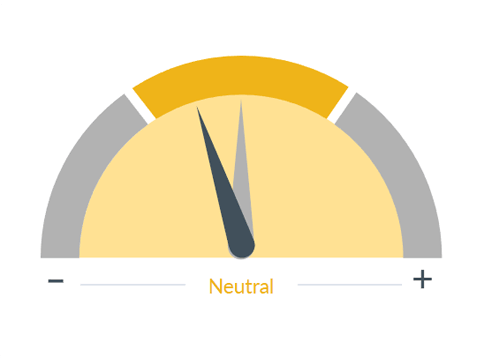
Monetary policy is one of two ways the government can influence the economy and financial markets. By manipulating interest rates, the Federal Reserve can raise or lower the cost of money to stabilize or stimulate the economy. For example, if the cost of credit is reduced, more people and firms will borrow money and the economy will grow. Higher interest rates will increase the cost of its debt, reducing borrowing and company profits, and may slow economic growth.
Dial 1: Monetary Policy, 2:20— With that in mind, we downgraded Monetary Policy, although it remains in yellow. The Federal Reserve has already raised rates once and has made it clear that inflation is still its primary concern. The question now is how much further it needs to go, which is still very much an open question.
■ Previous Month ■ Current Month
Housing / Mortgages
What we see
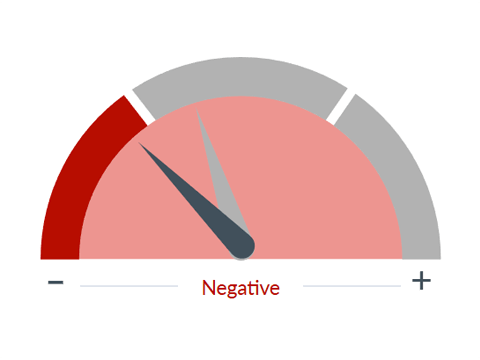
Housing is an important indicator of the overall economy and a key driver of investment and job growth. We look at such things as starts, permits, foreclosures, delinquencies, and bank lending to assess the sector's health.
Dial 2: Housing / Mortgages, 2:35— We also downgraded Housing and Mortgages from yellow to red. This is probably the easiest change to see in everyday life. Mortgage rates above seven percent makes buying a home substantially more difficult, particularly for first-time buyers. Existing homeowners who locked in much lower rates remain relatively insulated, but every month more households have to make decisions at today’s borrowing costs.
■ Previous Month ■ Current Month
Credit Demand / Availability
What we see
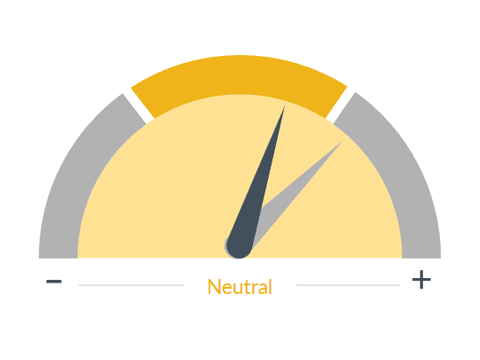
Availability of credit from banks and the overall financial sector to provide capital to the economy. Restrictive credit conditions are a headwind to economic activity, while accommodating conditions may boost it.
Dial 3: Credit Demand / Availability, 2:58— Credit Demand and Availability also moved down, from green to yellow. Credit is still available. We are not seeing the type of widespread stress that would suggest the financial system is pulling back from borrowers. But money has become more expensive. So this is less about credit disappearing and more about the cost of credit beginning to influence decisions.
■ Previous Month ■ Current Month
Energy Costs
What we see
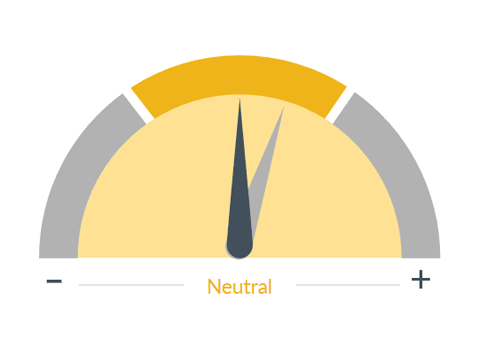
Significant changes in energy/oil prices can have important but differing impacts on the overall economy. Higher energy prices act as a tax on consumers and businesses, absorbing money that would normally be used to buy other goods. However, they can also boost production and investment in the mining and energy sectors of the economy. Lower energy prices can increase consumer spending and lower manufacturing costs.
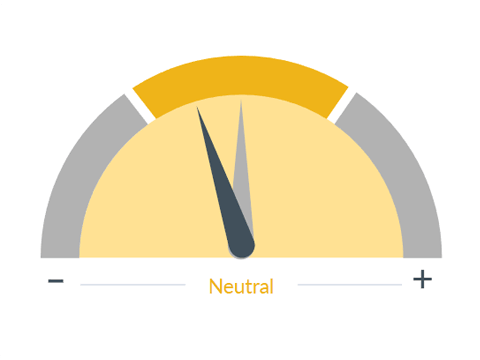
Dial 4: Energy Costs, 3:16— We also lowered Energy Costs within yellow. Here, our view has become less confident. We had been expecting more progress toward a resolution in the Middle East and some normalization in energy markets. That has been slower to develop than we hoped. So rather than make a strong directional call, we moved the dial closer to neutral.
■ Previous Month ■ Current Month
Interest Rates
What we see
Interest rates control the flow of money in the economy. High interest rates curb inflation, but also slow down the economy. Low interest rates stimulate the economy, but could lead to inflation. Interest rates affect the economy slowly. When the Federal Reserve changes the Fed Funds rate, it can take 12-18 months for the effect of the change to percolate throughout the entire economy.
Dial 5: Interest Rates, 3:37— Finally, we downgraded Interest Rates while keeping the indicator yellow. This reflects the magnitude of the move we have seen in longer-term yields. Our own forecasts for both the Federal Funds Rate and the 10-year Treasury have moved higher. But there is an important distinction here. Higher rates are a headwind, but they are not necessarily evidence of a weak economy. In fact, part of the increase in rates is occurring because economic activity remains strong and the demand for capital is exceptionally high.
The key is how long rates remain elevated and at what point higher borrowing costs begin to change behavior. Even with the downgrades, we still see an advancing market, and that tension is really the story behind this month’s Speedometer changes. We have become more cautious about the cost of money without becoming more negative about the underlying economy.
What I want to emphasize is that we are increasingly seeing actual economic activity outperform expectations and sentiment. We won’t disagree that inflation is still too high, and that energy continues to create real pressure for households. But we are not seeing evidence of a wage-driven inflation cycle, where wages and prices begin chasing each other higher.
Worker earnings are growing at the slowest annual pace since 2021, and core inflation has also looked somewhat better after recent revisions, which gives the Federal Reserve more room to be patient. That’s why expectations for a rate hike in October have plunged from above 70% to below 20%.
From a portfolio perspective, this is where emotion can become expensive. There is an old market lesson that says the best opportunities often appear when fear is widespread, while the time for caution often comes when everyone feels comfortable. The problem is that fear never feels attractive while you are living through it. Our instincts often tell us to wait until uncertainty disappears, but the market rarely gives us that luxury.
Our view remains constructive. We continue to favor equities and we also continue to build global diversification rather than requiring one country or one investment theme to carry the entire portfolio.
There are risks. Interest rates are high, energy remains volatile, and politics will become louder as we approach the midterms. But underneath the emotion, economic activity continues to move forward.
This month, perhaps the simplest way to think about the Speedometers is this. Mr. Fear is worried. Dr. Fundamentals sees healthy economic activity. And for now, we think investors should pay attention to what the economy is doing, not simply how everyone feels about it.
Important Information
RBC Rochdale, LLC is an SEC-registered investment adviser and wholly-owned subsidiary of City National Bank. Registration as an investment adviser does not imply any level of skill or expertise. City National Bank is a subsidiary of Royal Bank of Canada.
The information presented does not involve the rendering of personalized investment, financial, legal or tax advice. This presentation is not an offer to buy or sell, or a solicitation of any offer to buy or sell any of the securities mentioned herein.
Certain statements contained herein may constitute projections, forecasts and other forward-looking statements, which do not reflect actual results and are based primarily upon a hypothetical set of assumptions applied to certain historical financial information. Certain information has been provided by third-party sources and, although believed to be reliable, it has not been independently verified and its accuracy or completeness cannot be guaranteed.
Any opinions, projections, forecasts, and forward-looking statements presented herein are valid as of the date of this document and are subject to change.
Rochdale Speedometers are indicators that reflect forecasts of a 6-to-9-month time horizon. The colors of each indicator, as well as the direction of the arrows represent our positive/negative/neutral view for each indicator. Thus, arrows directed towards the (+) sign represents a positive view which in turn makes it green. Arrows directed towards the (-) sign represents a negative view which in turn makes it red. Arrows that land in the middle of the indicator, in line with the (0), represents a neutral view which in turn makes it yellow. All of these indicators combined affect RBC Rochdale’s overall outlook of the economy.
RBC Rochdale, LLC, its managed affiliates and subsidiaries, as a matter of policy, do not give tax, accounting, regulatory, or legal advice, and any information provided should not be construed as such.
All investing is subject to risk, including the possible loss of the money you invest. As with any investment strategy, there is no guarantee that investment objectives will be met and investors may lose money. Diversification does not ensure a profit or protect against a loss in a declining market. Past performance is no guarantee of future results.
©2026 RBC Rochdale, LLC. All rights reserved.


 Top
Top